




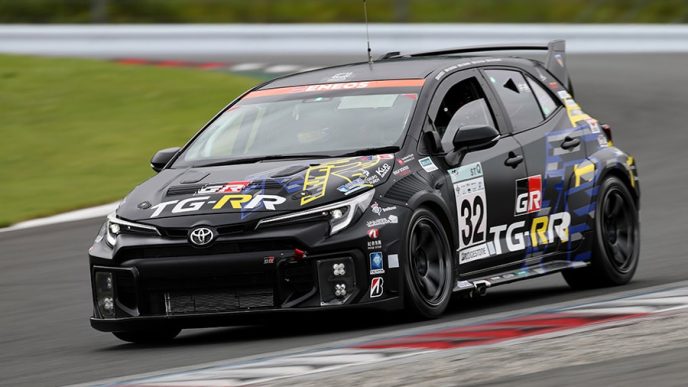
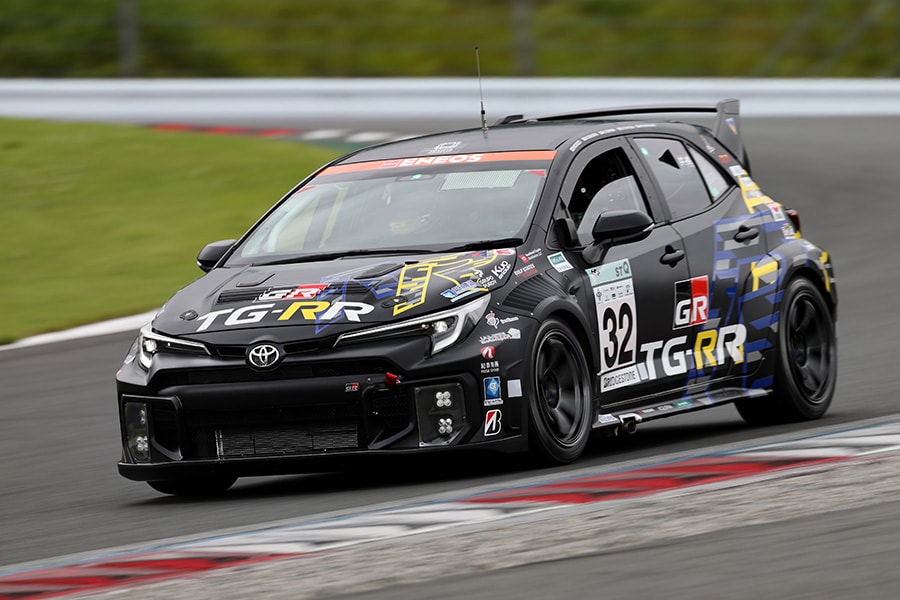
Toyota Motor Corporation (Toyota) will compete in the ENEOS Super Taikyu Series 2026 Empowered by BRIDGESTONE Round 3 NAPAC Fuji 24 Hours Race, taking place on June 5 and 6, with the #32 TGRR GR Corolla H2 concept (the liquid hydrogen-powered GR Corolla), which runs on liquid hydrogen and will become the world’s first race car equipped with a superconducting liquid hydrogen pump to compete in a race.
Further Evolution of the Liquid Hydrogen-Powered GR Corolla
Until now, the hydrogen-powered GR Corolla has taken on challenges aimed at applying hydrogen engine technology to future production vehicles, including transitioning from gaseous to liquid hydrogen fuel, developing combustion technology that delivers both high output and fuel efficiency, creating a durable pump capable of continuous operation at maximum output, and developing technology enabling fast and safe hydrogen fueling.
Now, the liquid hydrogen-powered GR Corolla will become the world’s first race car equipped with the superconducting liquid hydrogen pump unveiled at the final round of the 2025 Super Taikyu Series. Competing under the harsh conditions of an actual race will help verify the pump’s performance and durability.
World’s First Use of Superconducting Liquid Hydrogen Pump Technology
On the liquid hydrogen-powered GR Corolla, when hydrogen is supplied from the fuel tank to the engine, the liquid hydrogen in the tank is compressed by a pump and transported to the engine. Starting with this race, the motor that powers the pump has been upgraded from a conventional electric motor to a superconducting motor.
Superconductivity is a phenomenon that occurs only at ultra-low temperatures, enabling maximum utilization of the -253°C environment of the liquid hydrogen. On earlier models, the motor unit was mounted on top of the tank, but relocating the entire unit inside the tank freed up additional space, making it possible to increase the tank capacity from 220L at the time of the final race in 2025 to a maximum of 300L an increase of more than 1.3 times.
In addition, lowering the mounting position of the motor unit, a heavy component, results in a lower center of gravity, which is expected to improve the vehicle’s dynamic performance.
Liquid Hydrogen-Powered GR Corolla Transitions to DAT
For this race, Toyota will also implement Direct Automatic Transmission (DAT), the first time that it has ever been paired with a hydrogen engine.
Toyota has developed DAT with the goal of achieving an automatic transmission that can compete on the same level as a manual transmission to broaden the base of motorsports. In comparison to a manual transmission, which requires specific driving skills, DAT aims to achieve some of the world’s fastest shift speeds, thereby enabling the driver to focus on driving without being distracted by shifting. By honing cars under the extreme conditions of motorsports, Toyota continues to pursue the full potential of automobiles.
Toyota will continue to develop technology through motorsports with its partners in the pursuit of making ever-better cars, based on its multi-pathway strategy for achieving a carbon-neutral society.